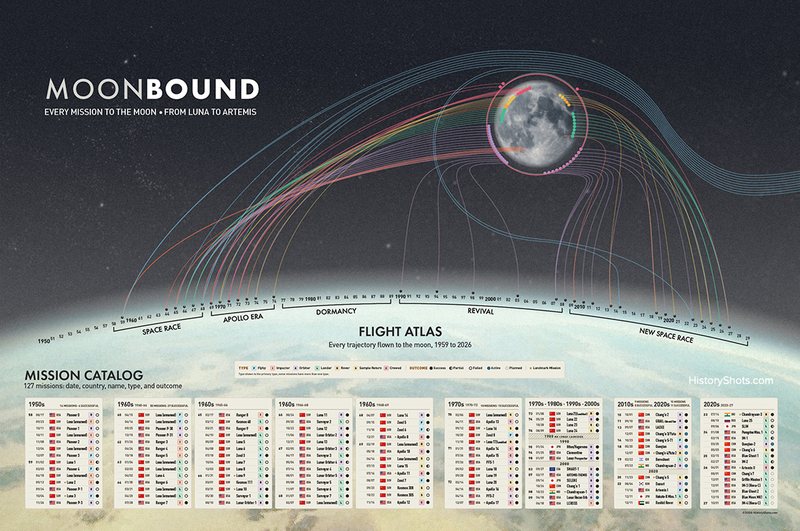
Mission Summary
Chang’e 6 was China’s sixth lunar mission and the first spacecraft in history to return samples from the Moon’s far side. Launched on May 3, 2024, by the China National Space Administration (CNSA), the mission was designed to collect lunar material from Apollo Crater within the South Pole–Aitken Basin, the largest and oldest impact basin on the Moon. Building on the success of Chang’e 5, the mission combined an orbiter, lander, ascender, and return capsule to accomplish one of the most technically challenging robotic missions ever attempted.
After landing on June 2, 2024, the spacecraft used both a drill and a robotic scoop to collect approximately 1,935 grams (4.27 pounds) of lunar rock and soil. The ascender then lifted off from the Moon’s far side, rendezvoused and docked automatically with the orbiter in lunar orbit, and transferred the samples before the return capsule began its journey back to Earth. The capsule landed safely in Inner Mongolia on June 25, 2024, completing the first successful sample-return mission from the Moon’s far side.
Chang’e 6 represented a major milestone in lunar exploration, providing scientists with the first direct samples from the Moon’s far side. These samples are expected to improve our understanding of the Moon’s early evolution, the differences between its near and far sides, and the history of the South Pole–Aitken Basin. The mission also demonstrated technologies that will support China’s future lunar exploration plans, including Chang’e 7, Chang’e 8, and the proposed International Lunar Research Station.
Sources and notes can be found on the Sources page.