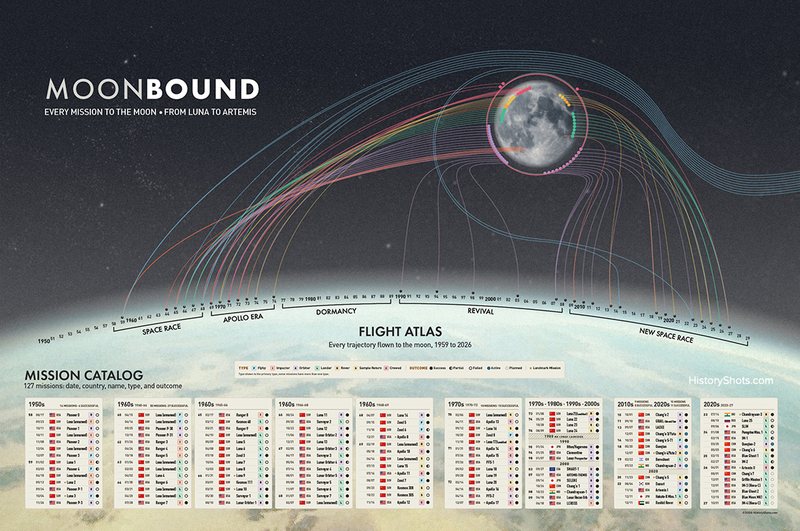
Mission Summary
Kosmos 305 was a Soviet mission launched on October 22, 1969, as part of the USSR’s effort to develop an automated lunar sample-return spacecraft. Although publicly designated as a Kosmos mission because it failed to leave Earth orbit, the spacecraft was actually a Ye-8-5 vehicle built for the Luna program. Its objective was to soft-land on the Moon, collect a sample of lunar soil with an automated drill, and return the sample safely to Earth, demonstrating the capabilities that would later be achieved by Luna 16.
Shortly after launch, the Proton-K rocket’s Block D upper stage malfunctioned, preventing the spacecraft from accelerating onto a trajectory to the Moon. Instead, Kosmos 305 remained in low Earth orbit before reentering Earth’s atmosphere approximately two days later. Because the mission never departed Earth orbit, the Soviet Union assigned it a Kosmos designation rather than a Luna mission number.
Although unsuccessful, Kosmos 305 played an important role in the development of the Soviet lunar sample-return program. The engineering lessons learned from this and other failed Ye-8-5 missions contributed directly to the success of Luna 16 in 1970, which became the world’s first robotic spacecraft to return samples from the Moon.
Sources and notes can be found on the Sources page.