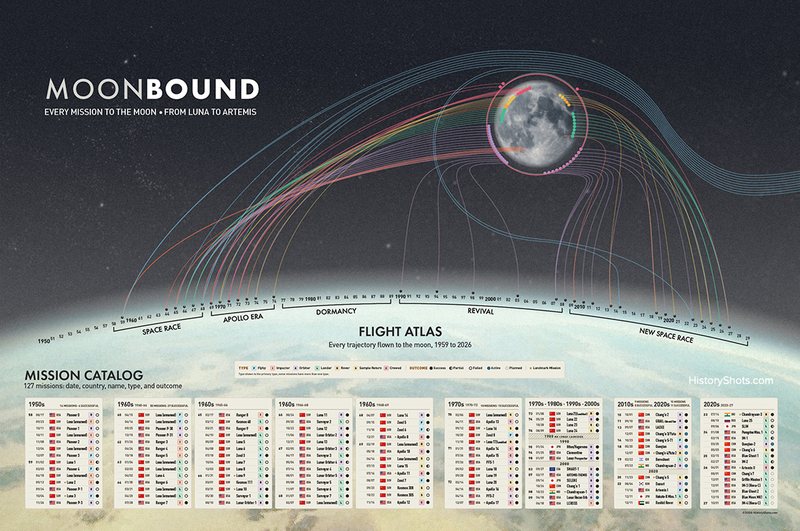
Mission Summary
The historic vanguard of humanity's direct deep-space exploration, Luna 1 launched from Baikonur Cosmodrome on January 2, 1959. Developed under the designation E-1 No. 4, it broke the Soviet streak of launch failures to become the first spacecraft to successfully slip past Earth's gravitational boundaries.
Engineers configured the 796-pound (361 kg) metallic sphere to smash into the lunar surface. It carried an innovative collection of scientific tools, including a gas-discharge detector, a scintillation counter, and a specialized canister that deployed a bright orange sodium gas trail in space to allow astronomers to track its trajectory. It also carried various Soviet state seals intended to be deposited on the Moon as historic territorial markers.
A critical oversight in ground control tracking altered its fate. Precisely during the upper-stage burn, engineers failed to account for the transit time of the radio control signals being transmitted to the rocket's guidance computer. This small command delay left the engine firing slightly too long, causing Luna 1 to overshoot its destination by 3,725 miles (5,995 km) on January 4. It drifted past the Moon, escaped Earth orbit completely, and settled into a permanent heliocentric orbit between Earth and Mars, becoming the first artificial planetoid in history.
Sources and notes can be found on the Sources page.