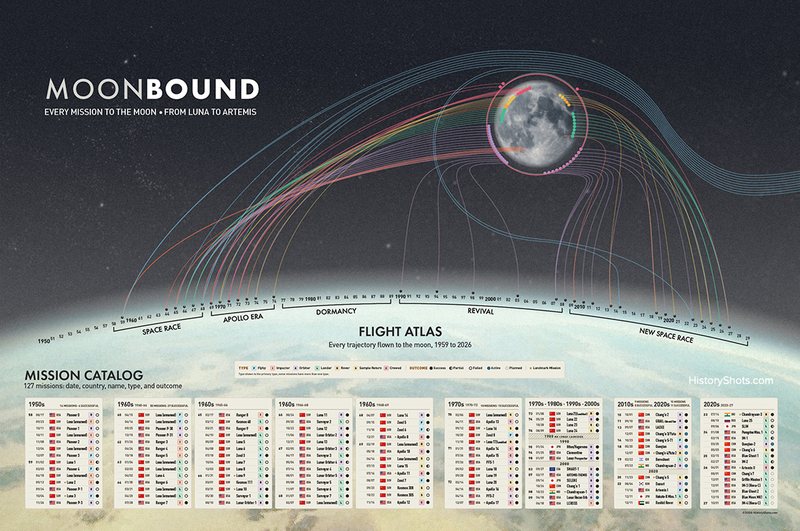
Mission Summary
Luna 21 successfully delivered Lunokhod 2, the Soviet Union’s second lunar rover, to the Moon on January 15, 1973. Building on the success of Lunokhod 1, the mission carried an upgraded rover equipped with improved cameras, enhanced scientific instruments, and greater mobility. After landing inside the eastern portion of Le Monnier Crater, Lunokhod 2 rolled onto the lunar surface and began an ambitious program of exploration, becoming the second robotic rover to operate on another celestial body.
Over the next four months, Lunokhod 2 explored a wide variety of terrain, including crater floors, hills, and rilles. It transmitted more than 80,000 television images and 86 panoramic photographs, conducted soil mechanics experiments, measured magnetic fields and solar X-rays, and continued laser-ranging experiments using a French-built laser reflector. The rover traveled approximately 37 kilometers (23 miles), a record for extraterrestrial surface travel that stood for more than four decades.
The mission ended after dust became lodged on the rover’s radiator, causing it to overheat during the lunar day. Despite its premature end, Lunokhod 2 dramatically expanded knowledge of the Moon’s surface and demonstrated that robotic rovers could perform complex, long-duration scientific exploration. Its achievements influenced the design of later planetary rovers sent to Mars and other worlds.
Sources and notes can be found on the Sources page.