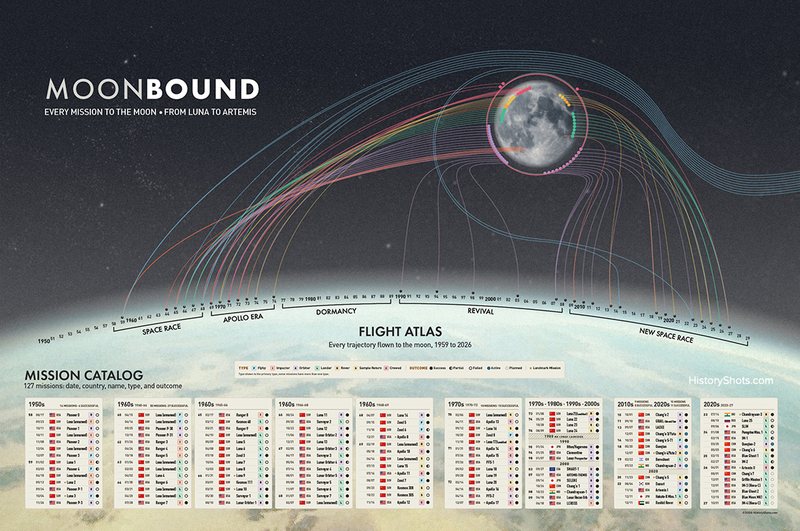
Mission Summary
Pioneer P-3 was the United States’ first attempt to place a spacecraft in orbit around the Moon, a bold leap beyond the flyby probes that came before it. Launched on Thanksgiving Day, November 26, 1959, from Cape Canaveral, it was the first of three advanced “paddle-wheel” lunar probes built by Space Technology Laboratories and the maiden flight of the new Atlas-Able rocket.
The 169-kilogram probe was a marked step up in sophistication. Four solar-panel paddles powered a heavy instrument suite that included magnetometers, radiation counters, and a small scanning camera meant to sketch a crude image of the Moon if the craft reached orbit. A hydrazine retro-engine was to brake the probe into a lunar orbit of roughly 6,400 by 4,800 kilometers after the long coast out from Earth.
The flight ended within its first minute. About 45 seconds after liftoff, while the Atlas was still firing, the rocket’s large fiberglass nose fairing began to tear away. Aerodynamic forces then ripped the upper stage and payload from the booster and destroyed them, and controllers lost contact with the tumbling rocket less than two minutes into the flight. Investigators traced the failure to the shroud, which had no venting to equalize the pressure difference as the vehicle climbed and so broke apart under the strain.
Sources and notes can be found on the Sources page.