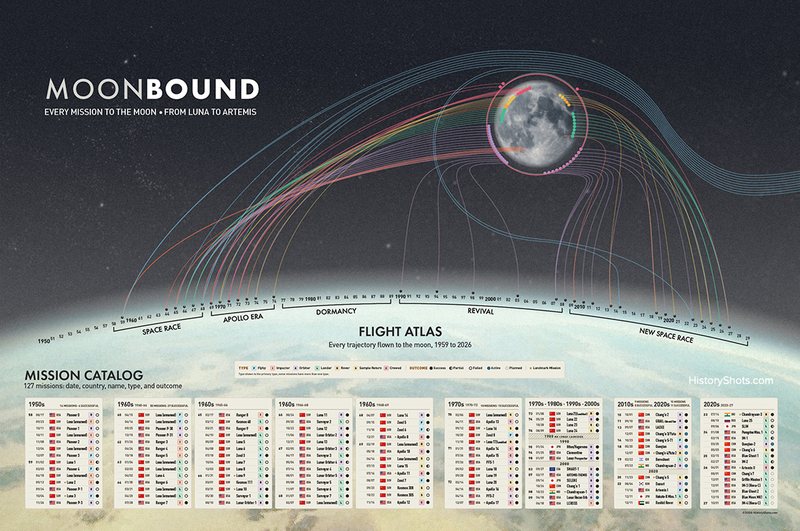
Mission Summary
SMART-1 was Europe’s first mission to the Moon and a major step forward in testing new ways to explore space. Launched by the European Space Agency on September 27, 2003, the small spacecraft used a highly efficient solar-electric ion engine instead of traditional rocket propulsion. Slowly but steadily, SMART-1 spiraled away from Earth, reaching lunar orbit on November 15, 2004, after a 13-month journey.
Once at the Moon, SMART-1 spent nearly two years studying the lunar surface. It created detailed maps of minerals and chemical elements, helping scientists better understand the Moon’s history, formation, and evolution. The mission also searched for clues about resources that could support future exploration.
SMART-1 ended on September 3, 2006, with a planned impact into the Moon. The mission proved that advanced ion propulsion could work beyond Earth orbit and marked Europe’s arrival as a lunar explorer.
Sources and notes can be found on the Sources page.