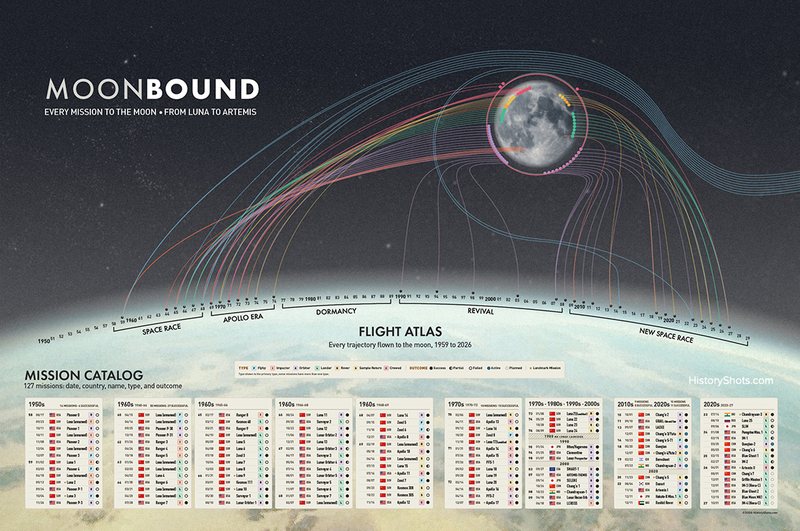
Mission Summary
The unnamed Luna mission launched on February 6, 1970, was the Soviet Union’s fifth attempt to develop an automated lunar sample-return spacecraft. Internally designated Ye-8-5 No. 405 and identified by NASA as Luna 1970A, the spacecraft was designed to soft-land on the Moon, drill into the lunar surface, collect a sample of lunar soil, and return it automatically to Earth. It was part of the Ye-8-5 series that eventually produced the historic Luna 16 sample-return mission.
The mission ended only 128 seconds after liftoff when a faulty pressure sensor caused one of the Proton-K launch vehicle’s first-stage engines to shut down prematurely. The rocket lost thrust, veered off course, and crashed before the spacecraft could reach Earth orbit. Because it failed before achieving orbit, the mission never received an official Luna designation and remained one of the Soviet Union’s unnamed lunar launch failures.
Although unsuccessful, the mission provided valuable engineering data that helped improve both the Proton launch vehicle and the Ye-8-5 sample-return system. Those lessons contributed directly to the success of Luna 16, launched just seven months later, which became the world’s first robotic mission to return samples from the Moon.
Sources and notes can be found on the Sources page.