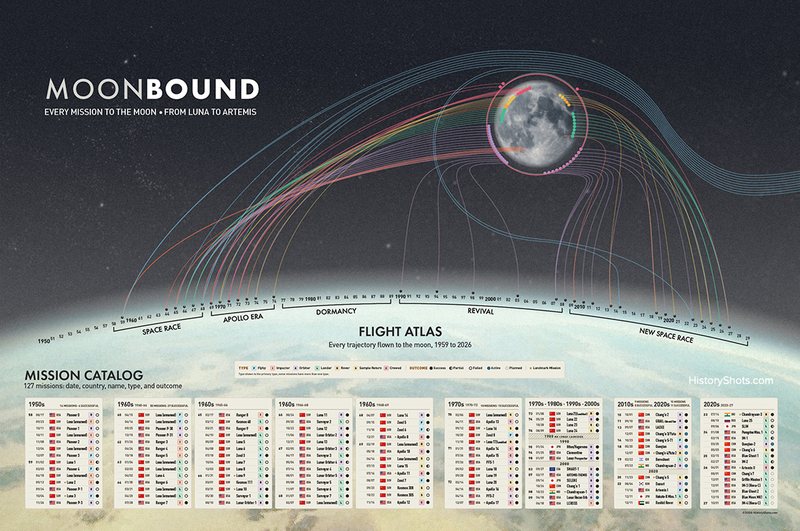
Mission Summary
Luna 19 was the first of a new class of advanced Soviet lunar orbiters, built on the heavy Ye-8 bus that also carried the rovers and sample-return landers. Launched September 28, 1971, it was designed to photograph the Moon in high resolution and to study its gravitational field from orbit.
It reached lunar orbit on October 2, 1971, but a failure in a gyroscopic platform left the spacecraft pointed incorrectly and stranded it in a higher orbit than intended. The planned high-resolution imaging was abandoned, and the panoramic pictures it did manage, taken while the craft spun for stability, came out blurred.
The mission found its real value elsewhere. Over 13 months and more than 4,000 orbits, far beyond its planned three, Luna 19 charted the Moon’s gravitational field and its mass concentrations, ran radio-occultation studies of the near-lunar environment, and contributed to coordinated solar-wind observations. Contact was lost on November 1, 1972.
Sources and notes can be found on the Sources page.