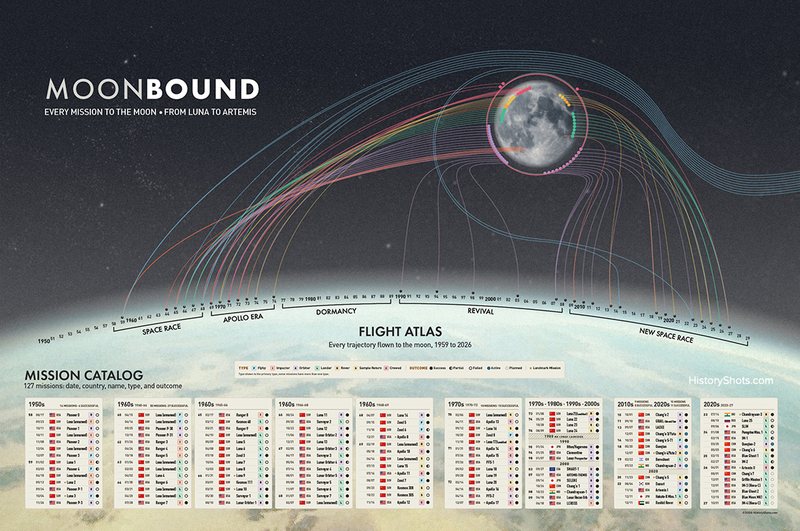
Mission Summary
The second clandestine launch of the Soviet E-1 series, this spacecraft lifted off from Baikonur Cosmodrome on the exact same day that NASA’s Pioneer 1 was launched. Known internally as Luna E-1 No. 2 (and classified by Western tracking networks as Luna 1958B), the mission was rushed to the pad to beat the Americans to a successful deep-space impact.
Like its predecessor, the 794-pound (360 kg) spherical probe was a bare-bones tech demonstrator designed to fly a direct intercept path. Its scientific goals were kept simple: measure micrometeoroid distribution, monitor cosmic radiation, and track interstellar gas densities as it hurtled toward a violent lunar crash.
The launch met a familiar, devastating end. Roughly 104 seconds into the flight, severe low-frequency oscillations shook the main booster stages apart, triggering a massive mid-air explosion. Structural engineers had tried to eliminate the destructive Pogo effect by adding special dampening valves to the fuel lines, but the resonance frequency simply shifted to a different section of the rocket. The Soviet government enforced a total media blackout on the incident, keeping the launch a closely guarded state secret for decades.
Sources and notes can be found on the Sources page.