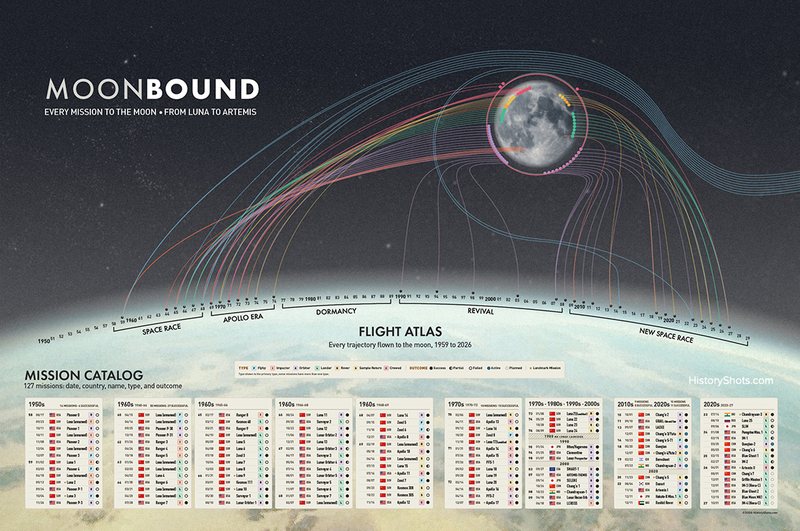
Mission Summary
Apollo 17 was the final mission of NASA’s Apollo program and remains the most recent human landing on the Moon. Launched on December 7, 1972, the mission carried astronauts Eugene Cernan, Harrison Schmitt, and Ronald Evans to the Taurus-Littrow Valley, one of the most scientifically promising regions on the lunar surface. Schmitt became the first and only professional geologist to walk on the Moon, bringing specialized scientific expertise to the mission.
Cernan and Schmitt spent more than 75 hours on the lunar surface, completing three moonwalks and driving the Lunar Roving Vehicle over 35 kilometers (22 miles). They deployed scientific experiments, explored the valley floor and surrounding mountains, and collected approximately 110 kilograms (243 pounds) of lunar rocks and soil, the largest sample collection of any Apollo mission. Evans remained in lunar orbit conducting scientific observations and later completed a deep-space spacewalk during the return to Earth.
Apollo 17 concluded the Apollo era with its most ambitious scientific expedition. The mission greatly expanded knowledge of lunar geology and left behind a lasting scientific legacy, while Cernan’s final footsteps marked the last human presence on the Moon, a distinction that continues today.
Sources and notes can be found on the Sources page.