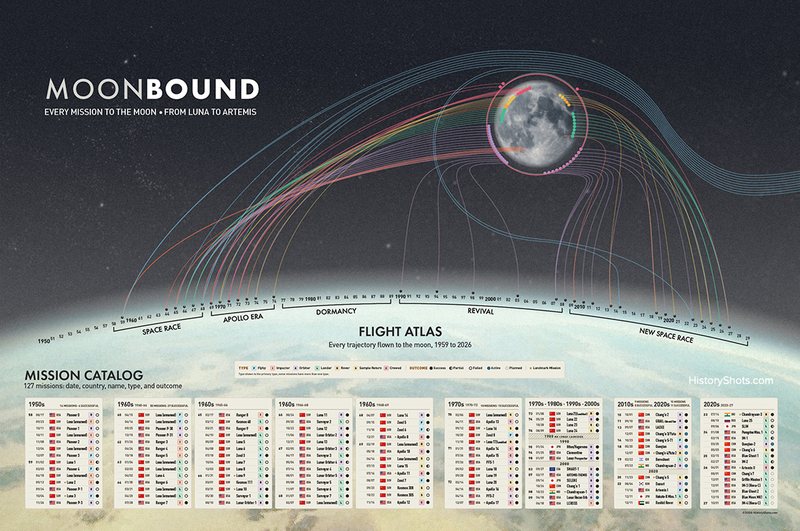
Mission Summary
Artemis II was the first crewed mission of NASA’s Artemis program and the first mission to carry astronauts beyond Earth orbit since Apollo 17 in 1972. Launched on April 1, 2026, the four-person crew aboard the Orion spacecraft completed a 10-day journey around the Moon, validating the systems and procedures needed for future lunar landing missions. The flight marked the first crewed mission of both the Orion spacecraft and the Space Launch System (SLS), opening a new era of human exploration beyond low Earth orbit.
After leaving Earth orbit, Orion traveled to the Moon on a free-return trajectory, passing behind the lunar far side before beginning its return to Earth. The astronauts tested Orion’s life-support, navigation, communications, and manual flight systems while documenting the lunar surface and conducting operational demonstrations throughout the mission. Orion successfully completed its high-speed reentry and splashed down safely in the Pacific Ocean on April 10, 2026, concluding NASA’s first crewed lunar mission in more than five decades.
Artemis II demonstrated that NASA and its international partners are once again capable of sending astronauts safely to the vicinity of the Moon. The mission validated the spacecraft, launch vehicle, and operational procedures that will support future Artemis missions, including the return of astronauts to the lunar surface and the long-term goal of establishing a sustained human presence around the Moon.
Sources and notes can be found on the Sources page.